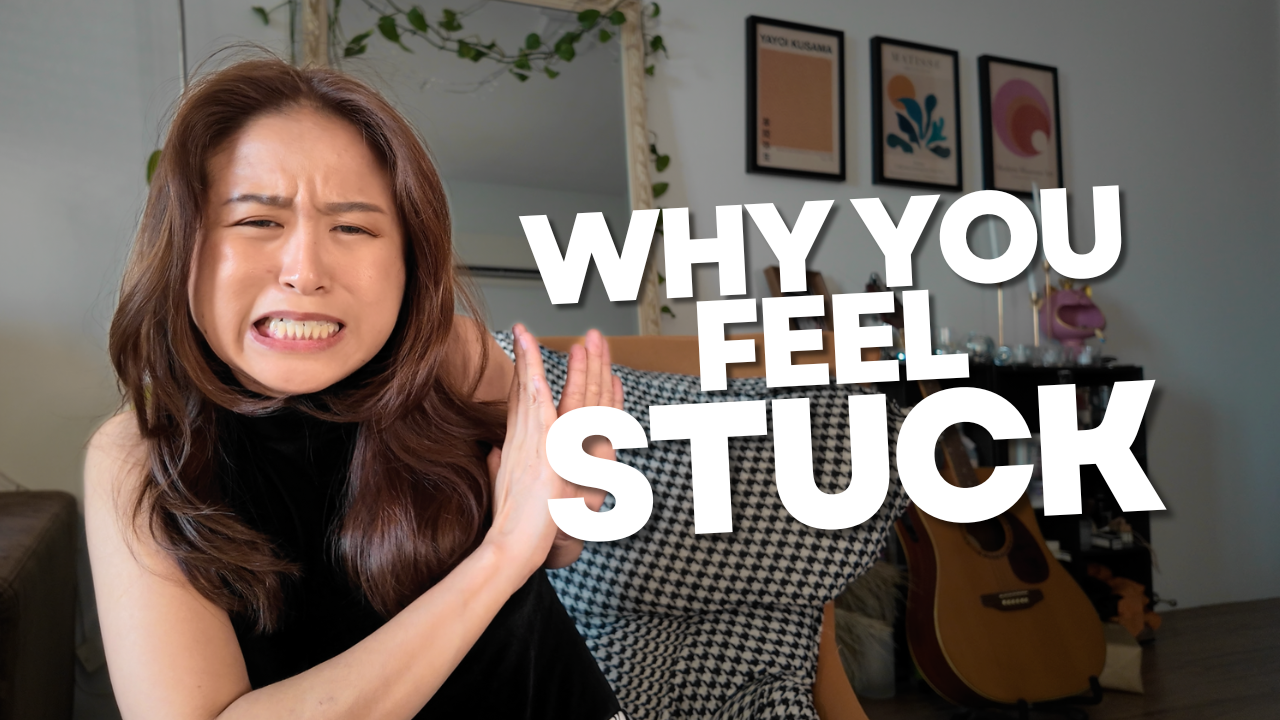
In this episode, we talked about:
- The three types of stuckness: fog, freeze, and fracture
- Why “just start” advice overlooks real-life responsibilities
- How consequences, invisible labor, and past experiences impact action
- The four pillars for sustainable growth: mind, body, systems, and community
- Reflection questions to create forward momentum
Listen to the full episode now:
“Stuckness is multi-faceted. It’s not just a mindset problem.”
Timestamp:
- 0:00 intro – you’re not lazy or scared, you’re just stuck
- 0:58 the three types of feeling stuck
- 1:05 “i don’t know what i want”
- 1:49 “i know what i want but i can’t move”
- 2:39 “i want too many things at once”
- 4:10 changing in your 20s vs your 30s
- 5:01 why the stakes feel higher now
- 6:21 invisible responsibilities women carry
- 7:30 the evidence you’ve collected that says you’re not enough
- 8:27 4 pillars to break out of feeling stuck
- 9:40 mind: shifting mindset & building mental resilience
- 10:40 body: nervous system safety before action
- 11:32 systems: small sustainable steps that actually work
- 13:06 community: why you can’t do this alone
- 14:11 reflection homework for next week
- 16:20 outro + working together
🌼 Love what we talked about?
Apply for 1-on-1 coaching to get unstuck and finally move forward: https://coaching.wendyvaz.com
Detailed Summary:
You know you want something different. You’ve given yourself permission to want more. You’ve been researching, scrolling, planning, and talking about it.
But somehow… you’re still stuck.
It feels like the handbrake is pulled up. You’re not lazy. You’re not incapable. Yet you just can’t move forward.
In this episode of Small Girl Big Talk, we break down why the popular “just start” advice often falls flat for women in their 30s and 40s — and what’s actually going on beneath the surface.
The Three Types of Stuckness
Before solving the problem, you need to understand what kind of stuck you’re experiencing.
- The Fog — “I don’t know what I want.”
You know you want something different, but you can’t name it clearly. You’re unsure whether it’s your job, your industry, your environment, or something deeper. You’re waiting for a lightning bolt moment of clarity — but clarity rarely arrives that way.
It comes from exploration, not waiting.
- The Freeze — “I know what I want, but I can’t move.”
You’ve researched. You’ve planned. You know the next step. But every time you try to act, you feel resistance, exhaustion, or perfectionism creeping in.
Your body shuts down. You procrastinate. You overanalyze.
It’s not laziness — it’s protection.
- The Fracture — “I want too many things.”
You want a career shift, better health, stronger relationships, more financial freedom, maybe a creative project too.
Everything feels urgent. Everything feels important.
And because you can’t do it all at once, you end up doing nothing.
Why “Just Start” Doesn’t Work in Your 30s and 40s
In your 20s, mistakes feel lighter. There’s more room to experiment. Fewer responsibilities. Lower stakes.
But in your 30s and 40s? Things are different.
You Have Real Consequences
There are mortgages, car loans, higher living expenses, senior job titles, and people who depend on you.
Your brain knows this. It recognizes risk more clearly now. So when you try to make a big change, it activates protection mode.
Staying stuck can feel safer than risking everything.
You Carry Invisible Loads
Especially as women, the mental and emotional labor grows heavier with age.
You’re thinking about your household, your career, your partner, your children, your aging parents, and everyone else’s emotional needs.
No wonder you’re exhausted.
It’s not that you lack ambition — your capacity is already stretched thin.
You’ve Gathered “Evidence”
Maybe you’ve tried before. Maybe it didn’t work out. Maybe you’ve internalized the belief that you’re “not good enough” or “not cut out for it.”
Your brain stores those past experiences as warnings. It tries to keep you safe by avoiding similar risks.
Stuckness isn’t just a mindset problem. It’s layered. It’s emotional. It’s physiological. It’s practical.
The Four Pillars That Actually Help You Move Forward
If “just start” isn’t enough, what is?
Breaking free from stuckness requires a holistic approach — not just motivation. Four key pillars support real momentum:
- Your Mind
Mindset shifts are important, but mental resilience matters just as much.
It’s not only about replacing limiting beliefs. It’s about expanding your capacity to handle stress, discomfort, and uncertainty. Growth requires emotional endurance.
- Your Body
Your nervous system needs to feel safe with change.
Growth means stepping outside your comfort zone, which your brain often registers as danger. Learning how to regulate your nervous system helps you stay grounded while doing hard things.
If your body feels unsafe, your mind won’t move forward.
- Your Systems
Big dreams feel overwhelming. That’s why sustainable systems matter.
You don’t need to focus on the distant goal. You need your next three baby steps.
When you build small, repeatable actions, you create evidence that you are capable. That evidence builds confidence. Confidence builds momentum.
- Your Community
You are not meant to do this alone.
Support systems expand your capacity. When you’re only relying on your own energy and perspective, progress feels heavier. But when you’re surrounded by people who understand your journey, hard seasons become more manageable.
Community doesn’t eliminate fear — but it makes courage easier.
Reflection Questions to Help You Get Unstuck
Instead of telling yourself to “just start,” try asking better questions:
- Which type of stuck am I? The fog, the freeze, or the fracture?
- What would be different if I could move forward — even by 1%?
- What’s one tiny experiment I could try this week?
Small experiments feel safer than life-altering decisions. And small progress is still progress.