What does it actually take to leave a comfortable life behind and build something from scratch?
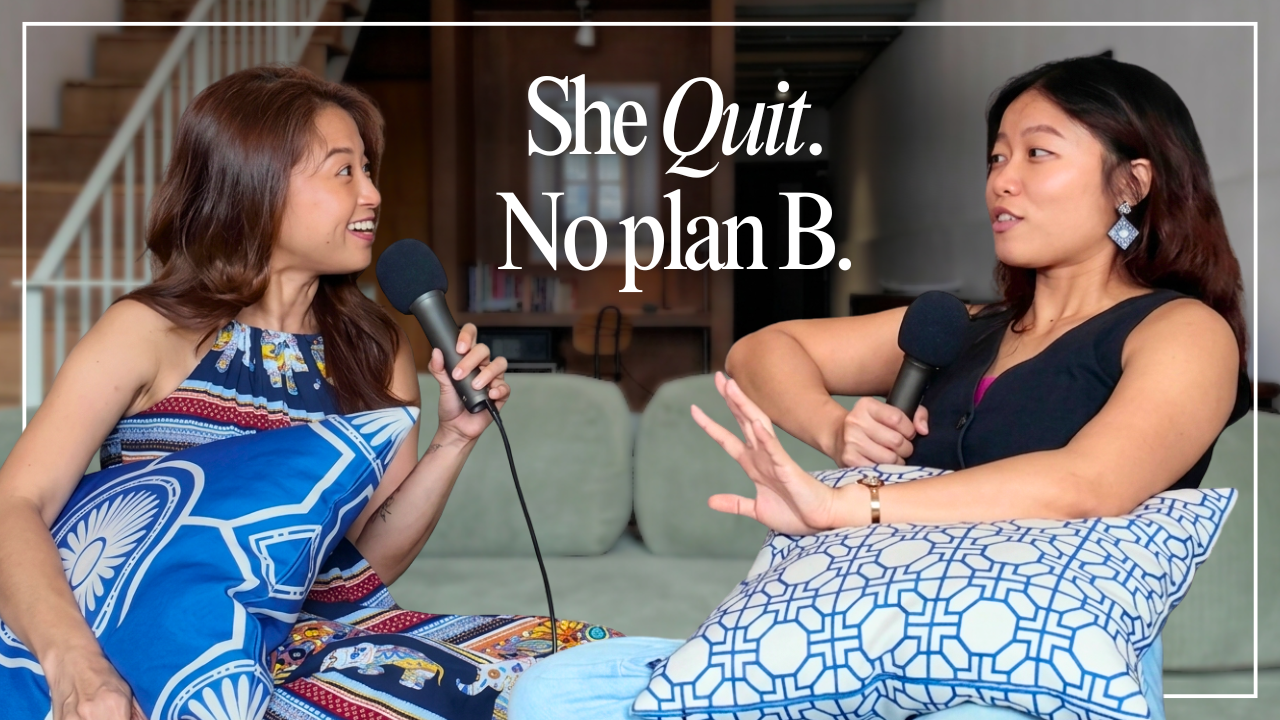
In this episode, I sat down with my friend Genevia, the founder of Wonkie Ice Cream in Penang, for a conversation that was packed with SO MUCH wisdom 🤯
On the surface, it’s a story about a girl who quit her engineering job in Singapore to sell ice cream; but when we really dived deep into the real journey… We talked about how it’s all about learning to trust yourself, dealing with imposter syndrome, figuring out who you are when you step outside the identity you’ve always known, and building something that actually feels like you.
We got into:
- why feeling miserable in a “good” job is information worth listening to
- how she went from home deliveries during MCO to running a full storefront
- why imposter syndrome is actually a signal (not a stop sign)
- what pitching to investors taught her about the rational vs. emotional mind
- the “lazy entrepreneur” approach to systems and delegation
- and the one question she asks herself every time fear shows up
This one’s for anyone who’s been sitting on a dream and waiting for the right moment.
Listen to the full episode now:
“What’s the worst that could happen? If you can accept the worst, then suddenly it doesn’t feel so scary anymore.”
Timestamp:
- 0:00 intro – meet Genevia & Wonkie Ice Cream
- 1:27 how we met in 2019 – the start of Genevia’s entrepreneurship journey
- 2:36 her corporate life in Singapore & why she was miserable
- 5:03 the phone call to her mom that changed everything
- 6:11 why she never even thought about finding another job
- 7:05 following joy as a compass before she even quit
- 8:47 does running a business kill the passion?
- 10:28 delegate what doesn’t spark joy
- 11:21 the moments she almost broke down
- 12:29 burnout, mindfulness & her morning routine
- 15:08 the identity shift: corporate girl to business owner
- 15:54 imposter syndrome is a signal, not a stop sign
- 19:42 why she chooses action over overthinking
- 20:45 pitching to investors & opening the storefront
- 23:12 selling the dream vs. knowing your numbers
- 24:39 when people question your vision, don’t take it personally
- 26:41 finding the right mentor for where you are
- 28:46 feminine energy in business – inside out
- 31:34 the lazy entrepreneur’s guide to SOPs
- 34:02 releasing the guilt of stepping back from your own business
- 36:13 what’s next for Genevia 39:89 advice for anyone with a dream: what’s the worst that could happen?
- 41:16 closing thoughts – make the unknown known
“Fear happens because of the unknown. If you make the unknown known, the fear becomes less powerful.”
🌼 Want to work with me? Apply for 1-on-1 Coaching here:
About Genevia:
Genevia is the founder of Wonkie Ice Cream, an ex-engineer who traded formulas for flavours and sees ice cream as a blank canvas for curiosity, creativity, and connection. Through Wonkie, she’s building a world that inspires people to explore life with more playfulness and courage, one unexpected scoop at a time.
🍦 Genevia’s Instagram: https://www.instagram.com/geneviachin/
🍨 Wonkie’s Instagram: https://www.instagram.com/wonkieicecream
Detailed Summary:
Many people dream about leaving their jobs and opening a café, dessert brand, or passion project one day. But dreaming and actually taking the leap are two very different things.
In this episode of Small Girl Big Talk, Genevia Chin, founder of Wonkie Ice-Cream, shares her journey from working as a chemical engineer in Singapore to building an ice cream business rooted in creativity, curiosity, and joy. The conversation goes beyond entrepreneurship and dives into identity shifts, self-awareness, fear, and what it really looks like to build something from scratch.
Walking Away From Stability to Follow Joy
On paper, life in Singapore looked comfortable. There was a stable job, good colleagues, and nothing was necessarily “wrong.” But despite having all the right ingredients for a successful life, something felt off.
Every day ended with a feeling of unhappiness and heaviness that became impossible to ignore.
Rather than searching for another corporate role, the decision became surprisingly simple: go home and build something different.
The funny thing? There wasn’t a detailed business plan from the beginning. Ice cream simply started as something exciting and enjoyable. It began with borrowing recipe books from libraries, experimenting at home, and inviting friends over for taste tests.
The compass was simple:
Follow what brings joy.
Passion Is One Thing. Running a Business Is Another.
Making ice cream and running an ice cream business are two completely different experiences.
There are operations to manage, staff to hire, accounts to track, systems to build, and unexpected problems to solve. The work becomes bigger than the original passion itself.
But over time, there was an important realization:
Not every part of the business has to bring joy.
Some tasks energize. Others drain.
Rather than forcing everything to fit into one role, delegation became part of the process. Accounting was outsourced. Kitchen operations were handed over. Energy shifted back into flavor creation, customer experiences, and the parts of the work that felt meaningful.
The goal wasn’t doing everything personally.
The goal was creating space to focus on what mattered most.
Identity Shifts and the Voice of Impostor Syndrome
Going from “employee” to “entrepreneur” wasn’t just a career shift. It was an identity shift.
There were moments of introducing herself as an ice cream founder and immediately hearing an inner voice ask:
“Who are you to call yourself that?”
Impostor syndrome appeared frequently, especially during the early stages.
But instead of treating it as proof of inadequacy, it became something else: a signal.
Sometimes self-doubt wasn’t saying “you’re not good enough.”
Sometimes it was simply pointing toward actions that weren’t being taken.
For example:
Wanting growth but avoiding visibility.
Wanting confidence but holding back from showing up.
Rather than getting stuck in the emotion, the focus shifted back to action.
Learning to Get Comfortable With Discomfort
Opening a storefront meant taking bigger risks: loans, investors, leases, renovations, and people questioning the vision.
And naturally, criticism hurt.
When people challenge something you’ve built, it can feel deeply personal because effort, identity, and dreams become intertwined with the work itself.
But one mindset helped create separation:
People can question the business idea without questioning your worth as a person.
“It’s the product, not yourself.”
That distinction made it easier to move forward without carrying every opinion as a personal attack.
Mentors, Systems, and Building a Sustainable Business
Growth wasn’t just about hustle.
Mentorship played a huge role in expanding possibilities and providing different ways of thinking.
Some mentors offered nurturing support and personal growth. Others brought structure, numbers, goals, and accountability.
Both perspectives mattered.
At the same time, systems became increasingly important. Small frustrations became opportunities to create better processes, clearer communication, and stronger structures.
Instead of repeatedly solving the same problems, systems helped create more freedom.
Ironically, becoming a “lazy entrepreneur” became a smart strategy.
Because when repetitive problems disappear, there is more room to focus on creativity and growth.
Looking Beyond Fear
One of the biggest takeaways from the conversation was a shift in perspective around fear.
Most people naturally focus on worst-case scenarios:
What if I fail?
What if it doesn’t work?
What if I regret it?
But there’s another question worth asking:
What if it works?
What if the best-case scenario happens?
Growth often lives somewhere between those two possibilities.
And fear tends to lose its grip once uncertainty becomes clearer.
Conclusion
This episode is a reminder that identity shifts rarely happen in one dramatic moment. More often, they happen through small decisions, uncomfortable actions, and learning as you go.
Building a dream doesn’t always start with certainty. Sometimes it starts with curiosity, with taking one step forward, and trusting that you’ll figure out the next one later.
Because sometimes the question isn’t just “What’s the worst that could happen?”
It’s also:
“What’s the best that could happen if you tried?”